


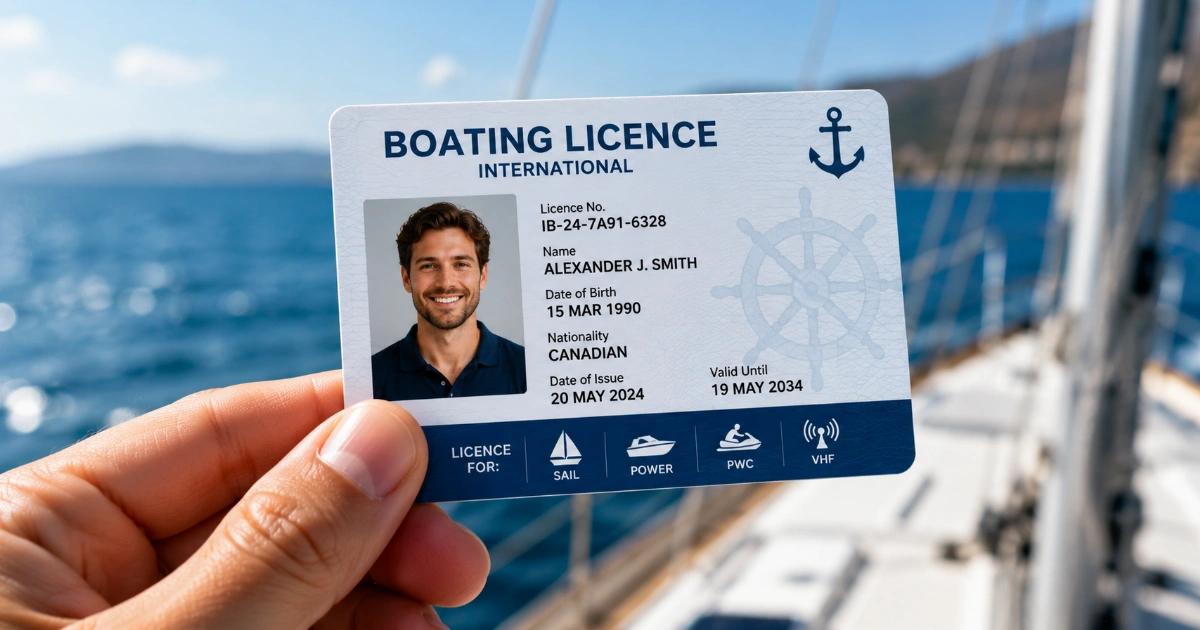
If you are just getting into sailing, one question comes up almost straight away: do you need a licence to sail?
It sounds like there should be a simple yes-or-no answer.
In reality, it depends on where you are and what kind of sailing you want to do.
The rules are different in the UK, the US and Canada - and they change again when you want to charter abroad.
The good news is that the basics are straightforward once you know what applies to you.
The short version
- In the UK, you do not need a general sailing licence for private leisure sailing.
- In Canada, you need a Pleasure Craft Operator Card (PCOC) if your boat has a motor - including sailboats with an auxiliary engine.
- In the US, there is no federal sailing licence, but most states require a boater education certificate for motorised vessels.
- You need the right radio qualification to use marine VHF legally - in the UK that is the Short Range Certificate (SRC).
- If you want to charter abroad, you will need proof of competence. In Europe, that usually means an International Certificate of Competence (ICC) or equivalent such as the NauticEd SLC or an IYT Bareboat Skipper certificate.
- Most beginners start with lessons, club sailing and crewing, not advanced certificates.
Why this question confuses so many beginners
The phrase "licence to sail" gets used loosely.
Some people mean a legal permit.
Others mean a recognised sailing qualification.
Others are really asking about charter rules in Greece, insurance conditions in Spain, or whether they need paperwork to use the VHF set.
Those are not all the same thing.
There is no single international sailing licence that covers everything.
But there are situations where a qualification matters and those situations differ depending on your country and your plans.
That is why sailors often seem to contradict one another. A
One person is talking about local day sailing. Another is talking about chartering in the Med. Another is talking about operating marine radio.
All three may be correct in context.
Do you need a licence to sail in the UK?
For most private leisure sailors in UK waters, no.
The RYA says plainly that although you do not legally need a licence to skipper a vessel in UK waters, qualifications can be used as proof of competence.
That does not mean training is optional in any meaningful sense. It just means the law does not impose a blanket skipper's licence on ordinary leisure sailing. If you are taking out a small yacht in settled weather on familiar local waters, the legal barrier is low.
The practical barrier is skill, judgement and safety.
And that is exactly why beginners who take sailing seriously tend to train anyway.
Do you need a licence to sail in Canada?
Canada does have a legal requirement, but it is not a sailing licence as such. If your boat has a motor - and that includes sailboats with an auxiliary engine, even if the engine is not running, you need a Pleasure Craft Operator Card (PCOC). This is a Transport Canada requirement that applies across all provinces and territories.
The PCOC involves passing a boating safety test and it never expires. If your sailboat has no motor at all, you do not need one, but most cruising sailboats do have an auxiliary engine.
Beyond the PCOC, there is no legal requirement for a sailing qualification in Canada. But as with the UK, training makes a significant difference.
This is broadly how most people learn to sail safely and build experience over time.
Sail Canada offers a structured pathway from Start Keelboat Sailing through to Basic Cruising, and International Yacht Training (IYT) has schools across the country offering everything from International Crew through to Bareboat Skipper.
Do you need a licence to sail in the US?
There is no federal sailing licence in the United States. However, most states require some form of boater education certificate, particularly for motorised vessels. The rules vary by state, some apply to all ages, others only to boaters born after a certain date, and some include sailboats above a certain size.
It is always worth checking your specific state's requirements. In practice, most recreational sailors in the US are not required to hold a formal sailing qualification, but training through organisations like NauticEd, IYT or local sailing schools is still the sensible route.
NauticEd is recognised by the US Coast Guard and NASBLA, and offers flexible online theory combined with practical assessments through partner schools worldwide.
For most beginners, sailing skills develop gradually over months or years rather than through a single course.
What beginner sailors actually do
Most newcomers do not begin by chasing advanced qualifications. They begin in a much more ordinary, sensible way.
They start at a local club or training centre
Whether it is an RYA centre in the UK, a Sail Canada school, an IYT partner school, or a NauticEd practical school, the entry point is usually the same: get on the water with qualified instruction and learn the fundamentals.
They learn the basics on smaller boats
Many sailors begin in dinghies or small keelboats. It is easier to understand wind, sail trim and boat balance when everything happens faster and more clearly.
They take a beginner course
For keelboat sailors, a structured beginner course is a natural first step. The RYA Competent Crew course and the IYT International Crew course are both five-day practical courses designed for complete beginners.
You learn the essentials of crewing - ropework, helming, sail handling and safety - and come away with a recognised qualification.
In Canada, Sail Canada's Start Keelboat Sailing course covers similar ground. NauticEd offers an Introduction to Sailing course that combines online theory with on-the-water practical assessment.
They crew before they skipper
This is one of the most underrated steps. Crewing teaches you what real sailing looks like:
- coming alongside in wind,
- reefing early, handling lines under pressure,
- making tea at sea,
- and dealing with all the little jobs that never make it into romantic sailing posts online.
Platforms like SailTies Crew Match make it easy to find crewing opportunities and connect with boat owners looking for crew, so you can build experience on different boats with different skippers.
Scan to download


They move into qualifications when their plans require them
For many, the next step after a beginner course is a skipper-level qualification. In the RYA system, that is Day Skipper. For IYT, it is International Bareboat Skipper.
NauticEd's pathway leads toward the Sailing License and Credentials (SLC). Sail Canada's equivalent is Basic Cruising. Each of these prepares you to take charge of a yacht, and each is recognised by charter companies when you want to sail further afield.
When qualifications matter
Using marine VHF radio
If your boat has VHF and you are the one using it, you need the appropriate radio qualification.
In the UK, Ofcom requires the Short Range Certificate (SRC). Similar requirements exist in other countries - check your national regulations if you are outside the UK.
Chartering in Europe
Most European charter companies require proof of competence before they will hand over a boat.
The ICC is the most commonly requested qualification in the Mediterranean and European coastal waters. UK sailors typically get it through the RYA after completing Day Skipper.
US-based sailors can use the NauticEd SLC, which is accepted by charter companies across Europe as an equivalent. IYT's International Bareboat Skipper certificate is also widely accepted.
Many sailors first build this experience through Mediterranean sailing adventures before chartering independently.
Chartering in the Caribbean
The Caribbean is generally less formal about licensing than Europe.
There is no blanket legal requirement for a sailing certificate, but charter companies will still want to see evidence of your experience and competence.
A recognised qualification helps, and most companies will ask you to submit a sailing resume in advance. Having your miles, qualifications and experience logged in one place - which SailTies makes easy - simplifies this process considerably.
Chartering elsewhere
Requirements vary by destination.
Some countries have specific local regulations, others defer to the charter company's own checks.
The safest approach is to hold a recognised qualification (ICC, SLC, or IYT Bareboat Skipper), have a solid log of your experience, and check with the charter company before you book.
Paperwork, registration and practical admin
If you take a boat outside your home country's territorial waters, registration and supporting paperwork become far more important. In the UK, the RYA notes that registration is essential if you wish to take your boat outside UK territorial waters. Similar requirements exist in other countries. So while beginners often fixate on the "licence" question, the real-world admin can be broader than that.
Sailing licence and training requirements at a glance
| Region | Do you need a licence to sail? | Legal requirements | Notes |
|---|---|---|---|
| UK | No general sailing licence required | SRC required for VHF radio use | RYA qualifications are widely respected as proof of competence but not legally mandatory for private leisure sailing |
| Canada | PCOC required if your boat has a motor | Pleasure Craft Operator Card (PCOC) - includes sailboats with auxiliary engines | PCOC never expires. No motor = no PCOC needed. Sail Canada and IYT training recommended |
| US | No federal licence | Most states require a boater education certificate for motorised vessels | Requirements vary by state. NauticEd is recognised by the US Coast Guard and NASBLA |
| Europe (chartering) | Proof of competence required | ICC, NauticEd SLC, or IYT Bareboat Skipper typically accepted | Requirements vary by country. Always check with your charter company |
| Caribbean (chartering) | No formal licence required | Sailing resume and proof of experience expected | Charter companies verify competence before handover. A recognised qualification helps |
| Other destinations | Varies | Check local regulations and charter company requirements | Hold a recognised qualification and a verified log of experience as a minimum |
Chartering requirements by destination
| Destination | Qualification typically required | Sailing resume needed? | Notes |
|---|---|---|---|
| Mediterranean (Greece, Croatia, Turkey, etc.) | ICC, NauticEd SLC, or IYT Bareboat Skipper | Yes | Most charter companies require formal proof of competence |
| Caribbean (BVI, Grenada, St Lucia, etc.) | Recommended but not always mandatory | Yes - often the primary check | Base manager may verify skills on arrival |
| Thailand / Southeast Asia | Varies by company | Yes | Some companies accept experience alone, others want formal qualifications |
| Australia / New Zealand | Varies by state or territory | Yes | Check local requirements as they differ by region |
| Canary Islands / Atlantic islands | ICC or equivalent | Yes | Treated as European waters for charter purposes |
Beginner qualification pathways
The exact pathway depends on where you are and which training provider you choose, but the progression is broadly similar.
| Stage | RYA (UK and worldwide) | IYT (worldwide) | Sail Canada | NauticEd (US and worldwide |
|---|---|---|---|---|
| Beginner / Crew | Competent Crew (5 days) | International Crew (5 days) | Start Keelboat Sailing | Introduction to Sailing (online + practical) |
| Skipper | Day Skipper (theory + practical) | International Bareboat Skipper (5 days) | Basic Cruising | Bareboat Charter Master bundle |
| Charter-ready qualification | ICC (apply after Day Skipper) | IYT Bareboat Skipper certificate | - | SLC (Sailing License and Credentials) |
| Advanced | Coastal Skipper, Yachtmaster | Yachtmaster Coastal, Yachtmaster Offshore | Intermediate Cruising | Advanced courses available |
Whichever pathway you follow, building experience between courses matters just as much as the courses themselves. Keeping a log of your miles and experience from early on helps when applying for the next course, chartering, or simply tracking your own progress.
SailTies lets you log your voyages and miles automatically, store your qualifications in one place, and build a verified sailing CV so when a charter company or course provider asks what experience you have, you have it all ready.
Scan to download
The bottom line
Whether you need a licence to sail depends on where you are and what you plan to do.
In many cases, there is no general licence required to get started.
But you will almost certainly benefit from training, and you will need specific qualifications for radio use, chartering abroad, or cruising in foreign waters.
The beginner sailors who do things properly do not ask "what is the minimum legal paperwork?" - they ask "what do I need to sail safely, confidently and without creating headaches for myself later?"
FAQs
Do you need a licence to sail a yacht in the UK?
You do not need a general licence to sail a yacht in the UK for private leisure sailing. The RYA says you do not legally need a licence to skipper a vessel in UK waters, though qualifications are widely respected as proof of competence.
Do you need a licence to sail in Canada?
Whether you need a licence to sail in Canada depends on your boat: you need a Pleasure Craft Operator Card (PCOC) if it has a motor, including sailboats with an auxiliary engine. Beyond that, there is no legal requirement for a sailing qualification, but training through Sail Canada, IYT or other recognised providers is strongly recommended.
Do you need a licence to sail in the US?
There is no federal licence needed to sail in the US, but most states require a boater education certificate for motorised vessels. Requirements vary by state, so check your local regulations. Training through NauticEd, IYT or local sailing schools is the best way to build competence.
What qualifications do I need to charter in Europe?
The qualifications you need to charter in Europe usually come down to proof of competence. The ICC is the most commonly accepted qualification. UK sailors can get it through the RYA after Day Skipper. US sailors can use the NauticEd SLC, which is accepted as an equivalent. IYT's International Bareboat Skipper is also widely recognised.
What qualifications do I need to charter in the Caribbean?
The qualifications you need to charter in the Caribbean aren't set by a blanket legal requirement, but charter companies will want to see evidence of your experience. A recognised qualification (Day Skipper, ICC, SLC, or IYT Bareboat Skipper) helps, along with a sailing resume showing your logged miles and experience.
Is the ICC the same as a sailing licence?
The ICC is not exactly the same as a sailing licence. It is an internationally recognised certificate intended to provide evidence of competence when requested abroad, most commonly used for chartering in European waters.
What is the NauticEd SLC?
The NauticEd SLC is the Sailing License and Credentials, an internationally recognised sailing qualification issued by NauticEd. It is accepted by charter companies worldwide as an equivalent to the ICC, and is particularly popular with US-based sailors.
Do I need a licence for marine VHF?
A licence for marine VHF is needed in the form of the appropriate radio qualification. In the UK, Ofcom requires the Short Range Certificate (SRC). Similar requirements exist in other countries.
What is the best first step for a complete beginner?
The best first step for a complete beginner is a local sailing club or recognised training centre. For keelboat sailing, beginner courses like RYA Competent Crew, IYT International Crew, Sail Canada's Start Keelboat Sailing, or NauticEd's Introduction to Sailing are all solid starting points.
How can I build experience between courses?
You can build experience between courses mainly through crewing, the best way to build sea miles and practical skills. SailTies Crew Match connects you with boat owners looking for crew, so you can find opportunities near you or further afield. Logging your voyages on SailTies as you go helps track your progress and builds a verified record of your experience.
How do I keep track of my qualifications and experience?
You keep track of your qualifications and experience by storing them in one place with SailTies, which lets you log your voyages and miles automatically. Qualifications from IYT and NauticEd can be imported and verified directly. When a charter company, course provider or skipper asks what experience you have, you can share your SailTies profile rather than hunting through paperwork.
Should a beginner get qualified anyway?
A beginner should get qualified anyway in most cases. Even where the law does not require a general sailing licence, training improves competence, confidence and safety. Recognised qualifications from the RYA, IYT, Sail Canada or NauticEd all serve as proof of competence and open doors when you want to charter, crew or skipper further afield.