


Learning to sail can feel like stepping into a completely new world. At first, there is unfamiliar language, shifting wind, ropes everywhere, and the sense that experienced sailors somehow know what is happening before it happens. But once you begin, sailing starts to make sense surprisingly quickly.
So, how long does it really take to learn to sail?
The answer is not a single number. You can understand the basics in a day or two, become a useful crew member within a few days of structured training, and build real confidence over months. Seamanship, however, takes longer. It develops through repetition, good judgement, and time spent on the water in different conditions.
That is part of what makes sailing so rewarding. You do not need to master everything before you enjoy it — but the more experience you gain, the more natural it feels.
The short version
- You can learn basic sailing skills in a weekend or a few lessons
- A 5-day course like RYA Competent Crew can make you a capable beginner
- Dinghies are often faster to learn on, but yachts involve more skills
- Docking, anchoring, navigation and weather judgement take longer
- Regular practice matters more than theory
- Most people feel comfortable as crew within weeks, and confident within 6 to 12 months
What beginners can realistically expect
Learning to sail happens in stages rather than all at once.
In your first few hours, you will usually learn how sails work, how to steer, how to tack, and how to stay safe on board. After a weekend or a few lessons, many beginners can already take the helm, assist with sails, and follow simple manoeuvres in light conditions.
For many people, this early stage is exactly what courses like RYA Competent Crew are designed for, taking complete beginners and helping them become active, useful crew members in just a few days.
There is a difference, though, between understanding what to do and feeling fully in control. Confidence comes from repetition. The more often you sail, the more natural everything becomes.
What affects how quickly you learn?
Your previous experience
If you have spent time on boats before, some aspects may feel familiar. Experience in dinghies, rowing or other watersports can help, but many sailors start from scratch. You can read more about how people actually learn to sail and what that journey looks like in practice.
The type of sailing you want to do
Dinghies usually teach the basics quickly because they respond immediately. Yachts and keelboats involve more systems, engines, navigation, anchoring, which all add complexity. Not sure which is right for you? Our guide to sailing vs yachting breaks down the key differences.
How often you practise
Consistency is the biggest factor. Sailing regularly builds skill far faster than occasional trips.
The quality of instruction
Structured training helps you learn the right skills in the right order. Organisations like the Royal Yachting Association, International Yacht Training, and NauticEd all offer recognised pathways. See our full overview of sailing qualifications to understand which route suits your goals.
Weather and conditions
Calm, steady conditions are ideal for beginners. To understand what wind strength works best when you are starting out, take a look at our guide to the best wind conditions for beginner sailors. Strong wind and busy environments add complexity and are best tackled later.
A realistic sailing learning timeline
Day 1: Understanding the basics
On your first day, you will usually learn the main parts of the boat, points of sail, basic steering, sail control and essential safety routines. It may not feel smooth yet, but you will start to understand how the boat moves and why. Our guide to parts of a sailboat is a useful reference before your first session.
After 2 to 5 days: Becoming a useful beginner
This is where most people begin to feel genuinely involved.
A structured five-day course such as RYA Competent Crew, IYT International Crew, Sail Canada Start Keelboat Sailing, or NauticEd Introduction to Sailing is designed to take you from complete beginner to active crew.
By this stage, you may be able to:
- Take the helm in steady conditions
- Tack and gybe with guidance
- Handle basic ropework
- Act as a dependable crew member
Key skills you'll start learning
Tacking is turning the boat through the wind (the bow passes through the wind). → Used when sailing upwind
Gybing is turning away from the wind (the stern passes through the wind). → Used when sailing downwind
It also helps to understand concepts like windward vs leeward and whether you can sail against the wind — both of which trip up many beginners early on.
For many beginners, this is the point where sailing shifts from confusing to enjoyable.
After 1 to 3 months: Growing confidence
With regular sailing, your movements become less hesitant. You begin to read the wind, spot gusts, and anticipate what will happen next.
This is where crewing regularly makes a big difference. The more time you spend on different boats and in different conditions, the faster your confidence grows.
After 6 to 12 months: Building real confidence
At this stage, sailing starts to feel more natural.
You are likely to be:
- More comfortable around marinas
- More aware of weather and changing conditions
- Better at staying calm when plans change
Many sailors at this point begin working towards a skipper-level course such as RYA Day Skipper, IYT Bareboat Skipper, or Sail Canada Basic Cruising. These courses focus on planning trips, making decisions, and taking responsibility on board.
After a year and beyond: Developing judgement
This is the stage that cannot be rushed.
Seamanship is not just about controlling a boat. It is about:
- Making good decisions early
- Avoiding problems before they develop
- Knowing your limits
That kind of judgement only comes with experience over time.
How yacht sailing changes the learning curve
Sailing a yacht involves more than just handling sails.
You may learn to steer and trim sails relatively quickly, but skippering requires managing the full picture, including mooring and docking, anchoring, engine use, navigation, collision regulations, tides and weather, and crew communication.
For navigation specifically, our guide to how to plan a sailing route is a good starting point once you are ready to move beyond crewing.
This is why formal training pathways are structured in stages. For example, the Royal Yachting Association progression typically looks like:
- RYA Competent Crew → learning to crew
- RYA Day Skipper → learning to skipper
Each step builds responsibility as well as skill.
If your goal is to charter or skipper your own yacht, it is best approached as a gradual process rather than something you learn all at once.
Do sailing courses speed up the process?
Yes, especially at the beginning.
A structured course like RYA Competent Crew can give you a strong foundation in just a few days. Follow-on courses like RYA Day Skipper help turn that foundation into independence. See our full guide to sailing qualifications to compare your options.
That said, qualifications are not the same as experience. Confidence comes from applying those skills repeatedly in real situations.
The fastest way to improve your sailing skills
The quickest route is simple: learn the basics, then sail as often as possible.
Ways to improve faster:
- Crew with experienced sailors
- Join a sailing club or racing crew
- Sail in a range of conditions
- Get regular time on the water
Courses provide structure, but progress comes from doing. If you are just getting started, our complete guide to getting started in sailing walks you through the practical first steps.
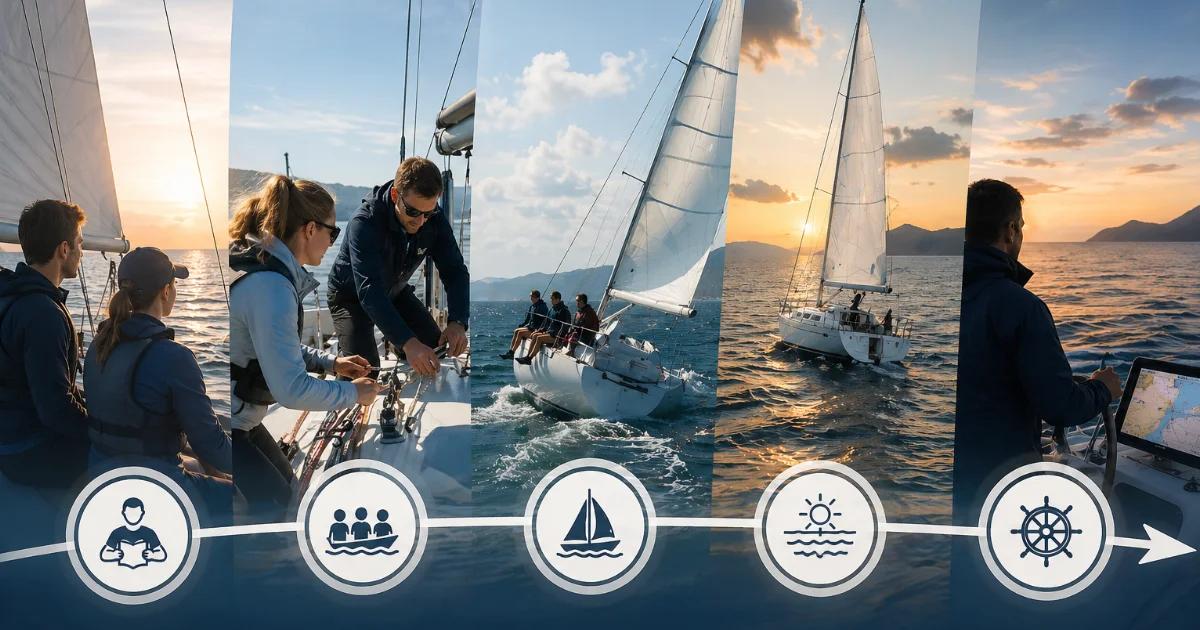
What the full journey looks like
- A few hours to understand the basics
- A few days (e.g. RYA Competent Crew) to become an active beginner
- A few months of regular sailing to feel comfortable
- 6 to 12 months before progressing to something like RYA Day Skipper
- Years to build real experience and judgement
You do not need to wait years before enjoying sailing. You can start quickly and improve steadily as you go.
FAQs
Can I learn to sail with no experience?
Yes, you can learn to sail with no experience. Many people start from zero. Courses like RYA Competent Crew are designed for complete beginners.RYA Competent Crew are designed for complete beginners.
Is sailing difficult to learn?
Sailing is not especially difficult to learn; the basics are more accessible than they appear. The challenge is building experience over time.building experience over time.
How long does it take to sail a yacht confidently?
How long it takes to sail a yacht confidently varies, but basic handling can come quickly, while safe skippering usually aligns with completing a course like RYA Day Skipper and gaining experience afterwards.safe skippering usually aligns with completing a course like RYA Day Skipper and gaining experience afterwards.
Is dinghy sailing easier to learn than yacht sailing?
Dinghy sailing is easier to learn than yacht sailing for many beginners. Dinghies teach quickly, while yachts involve more systems and seamanship.Dinghies teach quickly, while yachts involve more systems and seamanship.
How often should I practise?
How often you should practise is ideally weekly. Consistency is the biggest driver of progress. is ideal. Consistency is the biggest driver of progress.
Do I need a qualification to start sailing?
A qualification isn't always needed to start sailing, but structured training helps you learn faster and more safely, especially if you plan to skipper later. Our sailing qualifications guide covers what is required and what is optional.sailing qualifications guide covers what is required and what is optional.
So, how long does it really take?
If your goal is to understand the basics, you can get there very quickly.
If your goal is confidence, independence and safe decision-making, it takes longer — and depends heavily on how often you sail.
Sailing rewards consistency, curiosity and time on the water.
Start simple, keep practising, and the confidence follows.