


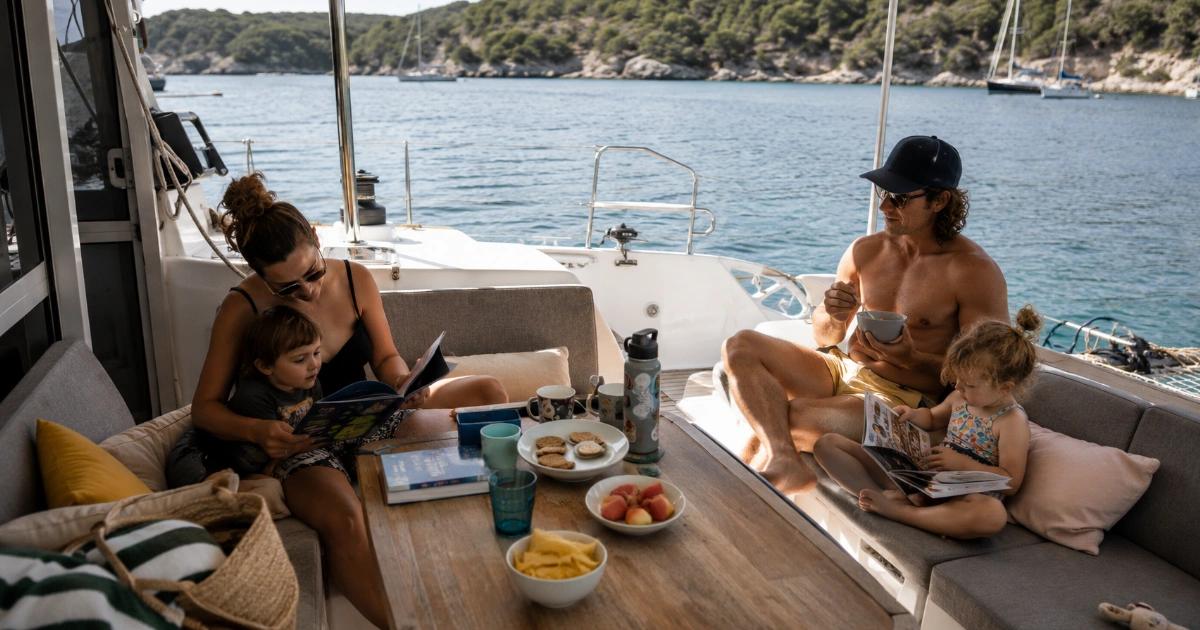
A sailboat needs to be 35 to 42 feet to comfortably fit most families. That range covers around 90% of family cruising scenarios, offering standing headroom, enough sleeping space for everyone, and at least one head with a shower.
Smaller boats around 30 feet can still work for a couple with one or two young children, but space gets tight fast once kids are old enough to need their own bunk and some privacy.
Log your family's next sailing trip with SailTies.
Track every passage, save the memories, and build a record of time on the water as a family.
Scan to download


In short
- Most families do well on a 35 to 42 foot sailboat, monohull or catamaran, for a typical week-long holiday
- Cabin count matters more than overall length: a family of four needs at least two cabins, a family of six or more needs three or four
- Catamarans deliver more usable space per foot than monohulls, so a 40 foot cat often feels roomier than a 45 foot monohull
- Boats over 42 feet (monohull) or 45 feet (catamaran) get noticeably harder for a family to handle without a professional skipper
- Kids need somewhere to be bored safely, not just somewhere to sleep: cockpit and deck space matter as much as cabin count
- On a skippered charter, boat size stops being a handling concern entirely, since the skipper manages the yacht regardless of length
Cabin Count Matters More Than Length
Cabin count is a better sizing guide than overall length. A family of four is typically most comfortable with at least two cabins, while three generations travelling together usually need three or four cabins to give every age group its own space.
As a rough benchmark, a 35 foot sailboat with three cabins is considered a solid comfort level for a family of four, with room to spare for occasional guests or grandparents joining for part of the trip.
Catamaran or Monohull for Family Space?
A catamaran delivers more usable space per foot than a monohull, since the accommodation spreads across two hulls plus a wide bridgedeck saloon, rather than being stacked into one narrow hull. A 40 foot catamaran often has more cabins, more communal space, and a bigger cockpit than a monohull several feet longer.
The trade-off is cost and manoeuvrability. Catamarans typically charter for more than a comparable monohull, and their wider beam takes more getting used to in a tight marina, even for an experienced skipper.
The table below gives a rough starting point by family size:
| Group | Recommended length | Minimum cabins |
|---|---|---|
| Couple with a baby or toddler | 30 to 35 ft | 1 to 2 |
| Family of 4 | 35 to 40 ft | 2 to 3 |
| Family of 6 to 8 | 40 to 45 ft | 3 to 4 |
| Three generations travelling together | 42 to 48 ft | 4 or more |
When a Boat Gets Too Big to Handle
A sailboat gets noticeably harder for a family to handle once it passes 42 feet for a monohull or 45 feet for a catamaran, especially without previous sailing experience. Sail area, winch loads, and docking all scale up with length, so a boat that looks only slightly bigger on paper can feel considerably more demanding underway.
On a skippered or crewed charter, this stops being a real concern. The skipper handles docking, reefing, and manoeuvring regardless of length, so a family can charter a larger, roomier boat than they would ever consider sailing themselves.
What Kids Actually Need Onboard
Cabin count answers where everyone sleeps. It doesn't answer where kids spend their day, and that matters just as much on a week-long trip.
Cockpit space is where most of the day actually happens: eating, playing cards, reading, swimming breaks. A cramped cockpit makes a boat feel small no matter how many cabins it has below.
A swim platform or easy-access transom makes getting in and out of the water simple for kids, without needing a ladder climb every time.
Shade over the cockpit or saloon matters more than most first-time charterers expect, since a week of unbroken sun with small children on board gets old fast.
Conclusion
There's no single right size for a family sailboat, but 35 to 42 feet with two to four cabins covers most families comfortably, whether that's a monohull or a catamaran. Beyond cabin count, prioritise cockpit space, shade, and easy water access: the things that decide how a week actually feels, not just where everyone sleeps at night.
If size and handling still feel like a big unknown, a skippered charter is the simplest way to remove that worry entirely and focus on choosing the boat that feels right for your family.
Frequently Asked Questions
What size sailboat is best for a family of four?
The best size sailboat for a family of four is 35 to 40 feet with two to three cabins. That range gives everyone their own sleeping space along with enough communal room in the cockpit and saloon to actually spend the day together.
How many cabins does a family sailboat need?
How many cabins a family sailboat needs depends on group size: a family of four typically needs two cabins, a family of six to eight needs three to four, and three generations travelling together usually need four or more to give each group privacy.
Is a catamaran better than a monohull for a family?
A catamaran is often better than a monohull for a family because it offers more usable space per foot and doesn't heel under sail, which many parents find reassuring with young children aboard. The trade-off is a higher charter cost and a wider beam that takes more care to dock.
Can a family manage a large sailboat without experience?
A family can manage a large sailboat without experience on a skippered or crewed charter, where a professional skipper handles docking and sail handling regardless of the boat's size. Sailing a large boat yourselves without experience is a different matter and isn't recommended.
How big a sailboat do you need for a family of six or more?
For a family of six or more, you generally need a sailboat between 40 and 45 feet with three to four cabins. Catamarans often work well at this size, since the extra beam adds space without adding as much length as a monohull would need.
Do bigger sailboats cost significantly more to charter?
Yes, bigger sailboats do cost significantly more to charter, and the jump is usually steeper for catamarans than for monohulls of the same length. Splitting the cost across a larger group often narrows the per-person gap, though, since more cabins mean more people sharing the same charter fee.
Ready to start logging as a family?
Download SailTies for free and keep a record of every trip, big or small.
Scan to download