


Most sailing knot guides list fifteen, twenty, sometimes thirty knots. That's not helpful if you're just getting started.
On a real trip you will reach for the same five or six knots again and again. The rest are specialist tools you can pick up later. Start with the ones that actually show up on the water, practice them until your hands do the work, and you'll be a useful crew member from your first sail.
This guide covers the sailing knots for beginners that matter most, what each one is used for, and how to build the muscle memory to tie them reliably even when conditions get uncomfortable.
The short version
- You don't need to learn dozens of knots: five or six will cover almost every situation on a real trip
- The bowline is the most important knot on any sailboat: it creates a secure, fixed loop that holds under load and releases easily
- The cleat hitch is the first knot you'll use every time you dock, and most beginners tie it wrong
- The figure-eight stopper knot keeps sheets and halyards from running through blocks and disappearing up the mast
- The clove hitch and round turn and two half hitches handle fenders, dock lines, and quick temporary attachments
- Practice at home with a short length of rope: muscle memory is the only way to tie knots reliably under pressure
How many knots do beginners actually need?
Most beginners need to know five to six knots to handle real-world sailing situations confidently. These cover docking, securing fenders, stopping lines from running, attaching gear, and creating fixed loops for a wide range of tasks.
You don't need to memorise a knot dictionary. What you need is to know a small set of knots so well that you can tie them one-handed, in the dark, on a moving deck. That level of reliability only comes from practice, and it comes faster than most beginners expect.
Sailing knots fall into three categories:
- knots tied at the end of a line
- bends used to join two lines together
- hitches used to fasten a line to a cleat, post, or rail.
A working sailor needs at least one from each category.
Scan to download


The Bowline: the knot every sailor learns first
The bowline is the most useful knot on a sailboat. It creates a fixed loop at the end of a line that holds firmly under load and can always be untied, even after carrying heavy strain.
On deck, you'll use it to attach a line to a dock cleat, to fix a sheet to the clew of a headsail, to tie off gear securely, and in emergencies as a rescue loop. The bowline has been in continuous use by sailors for at least 500 years because nothing replaces what it does.
The classic method for learning it is the rabbit analogy: the working end of the line is the rabbit. Form a small loop in the standing part (the hole). Pass the working end up through the loop (the rabbit comes out of the hole). Wrap it behind the standing end (around the tree). Then bring it back down through the loop (and back into the hole). Pull tight.
Practice this until you can do it without thinking about the steps. Once it clicks, it stays with you. The bowline is also the foundation for understanding a family of related knots you'll encounter as your sailing develops.
The Cleat Hitch: the first knot you'll use every time you dock
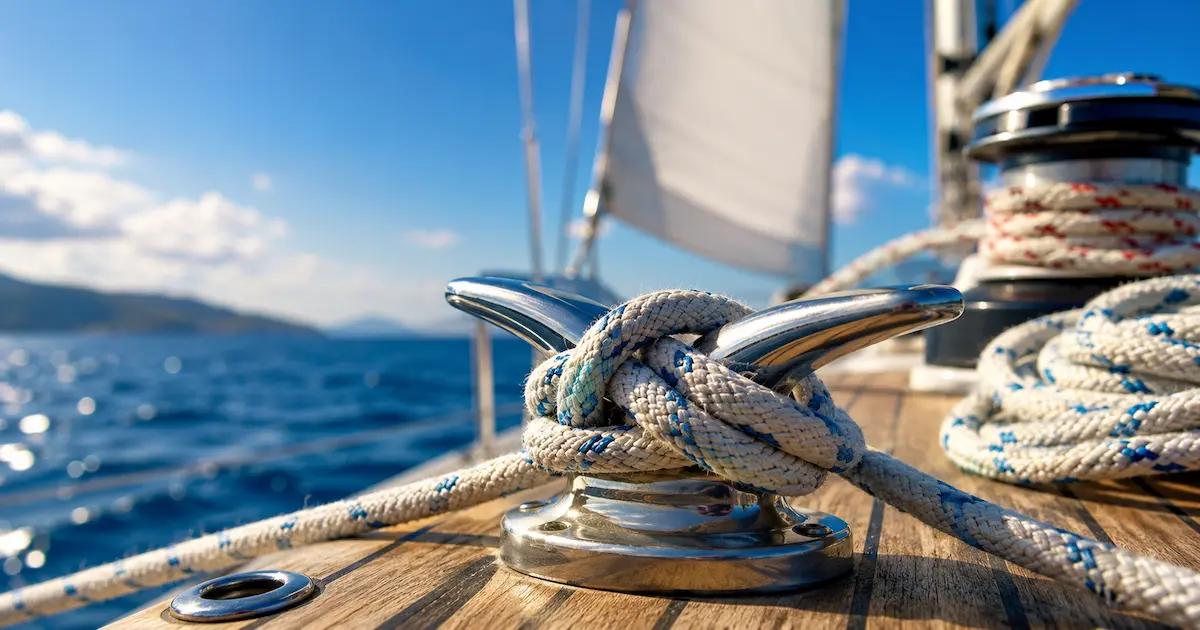
The cleat hitch secures a line to a cleat, the horn-shaped fitting found on docks and on the boat itself. You will use this knot every single time you dock.
Most beginners get this wrong, not because it's difficult, but because the most common mistake is overdoing it. The goal is a knot that holds firmly but releases instantly when you need it. Adding too many wraps makes it jam under load, and on a busy dock that's a real problem.
The correct method: take a full wrap around the base of the cleat, under both horns. Cross the line in a figure-eight around each horn. On the final pass, flip the line into an underhand loop and slip it over the near horn. Pull tight. That's it. The locking hitch at the end is what keeps it secure without creating a tangle.
Understanding how a sailboat works helps you see why cleats are positioned where they are and why getting the hitch right matters for controlling load distribution on the dock lines.
The Figure-Eight Stopper Knot: keeping lines where they belong
The figure-eight is a stopper knot. Its job is to prevent a line from running through a block, fairlead, or fitting and disappearing into the rig.
On a sailboat, every sheet and halyard needs a stopper knot at its end. If a jib sheet runs out of its block mid-tack, someone has to re-run it quickly while the boat is moving. If a main halyard runs up the mast, getting it back down is a significant headache. A figure-eight at the end of each line prevents both.
It's the simplest knot to tie: form a loop in the line, cross the working end over the standing part, then pass it behind and up through the loop. Pull tight. The result is a compact, reliable stopper that holds under load and is easy to undo when you need to.
It's also worth learning the parts of a sailboat early, so you can identify which lines need stopper knots and where each one runs through the rigging.
The Clove Hitch: fast and temporary
The clove hitch is the go-to knot for attaching a line quickly to a post, rail, or stanchion. It's especially useful for securing fenders to the lifelines before docking, where you need to position them quickly and adjust their height easily.
It ties fast: take two overlapping turns around the object with the working end crossing over the standing end, tuck the working end under the last turn, and pull tight.
There's an important limitation: the clove hitch can work loose under intermittent or rotating loads. It's a temporary knot, not a permanent fastening. If the line isn't under constant pressure, or if it can rotate around the object, the clove hitch can come undone.
Don't use it to secure a boat to a dock overnight or in any situation where failure would matter. For those cases, use a bowline or a round turn and two half hitches instead.
Round Turn and Two Half Hitches: the reliable dock line knot
The round turn and two half hitches is a more secure alternative to the clove hitch for attaching a dock line to a post or ring. It handles variable loads better and is the knot to use when you need confidence that the line will stay put.
To tie it: take two full wraps around the object (the round turn). This distributes the load and gives you control of the line. Then tie two half hitches around the standing part by passing the working end over and under the standing end, through the loop you've created, twice. Pull each one snug against the previous.
The round turn absorbs most of the strain, which means the half hitches only need to lock the knot, not carry the load. That's why it holds reliably even when conditions change.
For a deeper look at what happens when you leave the dock, see Sailties' guide to how people learn to sail, which covers the broader skill-building process beyond knot work.
The Reef Knot: for sails, not dock lines
The reef knot (also called the square knot) joins two ends of the same line or two lines of equal diameter. In sailing, its main use is reefing: bundling and tying off the excess sail when you reduce sail area in stronger wind.
It's easy to tie: cross right over left, then left over right, and pull tight. The pattern must alternate or you end up with a granny knot, which jams and provides no security.
One important caution: the reef knot should not be used to join two separate lines under load. It slips and comes undone when not under consistent tension, particularly with modern synthetic lines. Its role is specifically for reefing and for bundling, not for critical fastening work.
Understanding when conditions call for reefing connects directly to reading the wind. Sailties' article on best wind for beginners explains the wind ranges where most beginners learn and where reefing starts to become relevant.
How to actually get good at sailing knots
Knowing how a knot is tied and being able to tie it reliably under pressure are two different things. The gap between them is practice, and the good news is that you can practice anywhere.
Keep a short length of rope with you. Tie knots while watching TV, waiting for a bus, or sitting at a desk. The goal is to reach a point where your hands move through the steps without conscious thought. That's the level you need on a moving boat, in the dark, or when someone is asking you to move quickly.
Learn what the finished knot should look like before you practice tying it. If you don't know what correct looks like, you won't know when you've tied it wrong. Study the shape, then practice building it from memory.
Once you're comfortable with the basics, your sailing resume and logbook become useful tools for tracking the contexts where you've applied each skill. Sailties' sailing resume template covers how to document sea time and practical competencies for charter companies and future crew positions.
Conclusion
Sailing knots for beginners don't need to be complicated. Five knots done well will serve you in almost every situation you'll encounter on a real trip: the bowline for fixed loops, the cleat hitch for docking, the figure-eight to stop lines running, the clove hitch for quick temporary work, and the round turn and two half hitches for reliable fastening under load.
Start with those. Practice them until your hands know the steps without your brain needing to think. Then pick up the reef knot for when you start working with sail trim and reefing.
When you're ready to go deeper, explore Sailties' guide to getting started in sailing and our breakdown of sailing basics to build a well-rounded foundation on the water.
Scan to download
Frequently Asked Questions
What are the most important sailing knots for beginners?
The five knots that cover most real-world situations are the bowline, the cleat hitch, the figure-eight stopper knot, the clove hitch, and the round turn and two half hitches. Learn these first and practice them until they're instinctive. The reef knot is worth adding once you start working with sail trim and reefing in heavier conditions.
How long does it take to learn sailing knots?
Most beginners can learn to tie the five core knots correctly within a few hours of focused practice. Tying them reliably under pressure, on a moving boat and without thinking, takes longer. Regular practice with a short piece of rope at home is the fastest way to build the muscle memory you need. A few minutes of daily practice over two to three weeks produces solid results.
What is the most useful knot in sailing?
The bowline is widely considered the most useful knot in sailing. It creates a secure, fixed loop that holds under load and can always be untied, even after heavy strain. It has a wide range of applications: attaching sheets to sails, securing lines to posts, tying off gear, and serving as an emergency rescue loop. Most experienced sailors reach for the bowline more than any other knot.
What is the difference between a knot, a hitch, and a bend?
In sailing terminology, a knot is tied at the end of a line to create a stopper or a loop. A hitch fastens a line to a fixed object such as a cleat, post, or rail. A bend joins two separate lines together. Understanding these categories helps you choose the right technique for each situation on the water.
Can you practice sailing knots without a boat?
Yes, and you should. All you need is a short length of rope. Practicing at home builds muscle memory that allows you to tie knots quickly and correctly on the water. Some sailors practice around a chair leg or a post to simulate tying to a dock cleat or a piling. The physical repetition is what makes the difference between knowing a knot and being able to use it reliably.