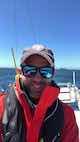
Robert Šarić founded and runs Veruda Sailing School in Pula, Croatia, teaching offshore passage-making, heavy weather technique and single-handed sailing.
His boat is Buri, a 2005 Elan 333 racing under ORC as CRO 3330 and equipped for offshore Category 2.
In the 2025 Rolex Middle Sea Race, about 250 miles from the finish, his crew found a cracked shroud in the middle of the night and repaired it halfway up the mast while still racing.
This season's ORC Worlds campaign took Buri past Etna, Stromboli and Vesuvius over three back-to-back courses.
He has logged 7,552 nautical miles on SailTies across 16 voyages and 105 days at sea.
Before he started Veruda Sailing School, Robert raced inshore and offshore regattas with a close group of friends. Now he runs the school out of Pula, at the southern tip of Istria, and takes paying crew on courses and race campaigns built around some of the toughest offshore sailing in the Mediterranean.
His crews range from complete first-timers to experienced commercial skippers. By late July this season, they had already sailed around 4,500 nautical miles together.
The boat is Buri, a 2005 Elan 333 racing as CRO 3330. She's a Rob Humphreys design, a performance cruiser built to race hard and still be lived aboard, and she's equipped to World Sailing Offshore Special Regulations Category 2. Below decks there's hot water and Webasto heating, which counts for a lot on a cold night watch.
Buri at the start of the 2025 Rolex Middle Sea Race.
About two-thirds of the way round the 2025 Rolex Middle Sea Race, roughly 250 nautical miles from the finish, the crew found something nobody wants to see in the middle of the night: cracked strands in one of Buri's steel shrouds.
A shroud that fails completely can take the whole mast with it. So the crew stayed calm and carried out an emergency repair in the dark, halfway up the mast, securing the rig while they were still racing.
Up the mast in the dark, securing the rig.
“It was a massive test of our grit, teamwork, and ability to handle high-stress offshore situations without panicking.”
They made Malta safely. The shroud was replaced, and Buri went straight back out on the next course: an 800-mile passage home to Pula.
The ORC World Championship at Sorrento, with race starts and finishes right under Vesuvius, including the famous Tre Golfi regatta.
The Siren's Wake: the cruise home from the Gulf of Naples to Pula, past Stromboli and Etna once more.
The Three Volcanoes Expedition, Pula to Naples: 798 nm, logged on SailTies.
Waiting for the Tre Golfi start signal, ORC Worlds 2026.
Stromboli, the “Lighthouse of the Mediterranean”, was on the Middle Sea Race course too. Pass it at night and you can watch it throwing glowing lava into the dark.
Robert teaches heavy weather technique and single-handed sailing on home water, and he chose it on purpose. The Adriatic is known for sudden, violent changes in the weather.
On an offshore course from Palagruža to Pula last year, the forecast suddenly deteriorated to gusts of up to 90 knots, hurricane force on the Beaufort scale. The crew changed the route straight away and rode out the worst of the system safely in shelter.
Alongside sudden Bora squalls, the Adriatic can throw up the hurricane-force Jugo, or Sirocco, with waves of over 10 metres on record. So you always have several bolt-holes mapped out before you leave.
“It demands a level of respect and proactive planning that calmer cruising grounds simply don't require.”
Heavy weather on the Tyrrhenian Sea, on the way home from Sorrento.
Ask Robert what people most often lack when they turn up for an advanced course, and it isn't a knot or a manoeuvre. It's managing their own energy: knowing when to sleep, how to stay hydrated, and how to get ahead of seasickness before it starts.
“You simply cannot explain to someone what multi-day, non-stop sailing feels like until they actually experience it.”
Once it gets rough offshore, a crew member who hasn't looked after themselves becomes a liability. They also miss the point of being out there. Let exhaustion or seasickness take over, he says, and what should be an incredible adventure just becomes a struggle.
Robert misses the instant trust of racing with friends who already know each other. With a new crew, his first job is to work out the gap between people's “advertised” experience and the real thing.
To keep a mixed crew safe in the early days, he relies on overlapping systems, like a rolling watch offset by an hour and a half, so a less experienced sailor is always paired with a seasoned one.
By the end of a six- to nine-day course, the crew is independent and works as one. In a regatta, his role shifts from managing them to fine-tuning their performance.
The crew in Sorrento, 800 miles after leaving Pula.
Even experienced crew have something to sharpen. On a five-day passage from Pula to Malta, Robert sailed with two skippers. Igor had already done two of his offshore courses, so Robert trusted him completely with the boat, and they finally got the spinnaker out for proper training.
Jernej was very experienced too, but mostly in day-hopping. So the focus with him was on offshore skills: handling the boat in a storm, especially single-handed, night navigation, and VHF communication for when things get serious.
Spinnaker training on the passage from Pula to Malta.
Running Veruda has made Robert's own sailing more methodical.
“It forced me to deconstruct my instincts into clear, actionable steps. Now, I anticipate issues much earlier and communicate solutions more calmly and upfront.”
For anyone curious about offshore sailing but nervous about it, Robert's advice is to drop the picture of constant, dramatic storms. The reality is more often fighting sleep in a chilly 20-knot breeze at three in the morning, holding a compass heading and keeping track of the commercial traffic around you.
Night traffic near the Kornati islands, on the chartplotter.
“That 3:00 to 6:00 AM watch is notoriously tough, yet I've actually had crew members actively trade shifts just to get it.”
They want the sunrise. Watching it come up over the open sea, or past an active volcano, recharges the batteries and makes every hard hour of the night worth it.
Want to log your own offshore miles?
Download SailTies for free and build your record, one voyage at a time.
Straight after the ORC Worlds, Buri raced La Cinquecento, the toughest regatta in the Adriatic, and made the podium for the second year running. Then came a Greek campaign that kicked off with the Aegean 600.