


Walk along any marina and you'll see a range of sailboats that look different from each other in obvious ways.
Some have one hull, some have two. Some carry one mast, others carry two. Some feel sporty and narrow, others wide and stable as a platform.
These differences are not cosmetic. Each configuration is a set of design choices that affect how the boat sails, how it handles in different conditions, and what kind of sailing it's suited for.
This guide covers the main sailboat types that appear regularly in sailing logs, what makes each one distinct, and what kind of sailor tends to use each one.
The short version
- Sailboat types are defined by two things: hull configuration (how many hulls) and rig configuration (number of masts and sail arrangement)
- The sloop is the most common sailboat in the world: one mast, two sails, simple to sail and maintain
- Catamarans are the fastest-growing type in charters and cruising logs, valued for stability, space, and comfort
- The ketch and cutter are the rigs most often logged by sailors on longer offshore passages, where a divided sail plan matters
- Monohulls outnumber multihulls overall, but catamarans dominate in charter fleets and liveaboard setups
- Understanding the basic types helps you read a marina, choose a charter boat, and make sense of your logbook entries
How are sailboat types classified?
Sailboat types are defined by two main factors: hull configuration and rig configuration.
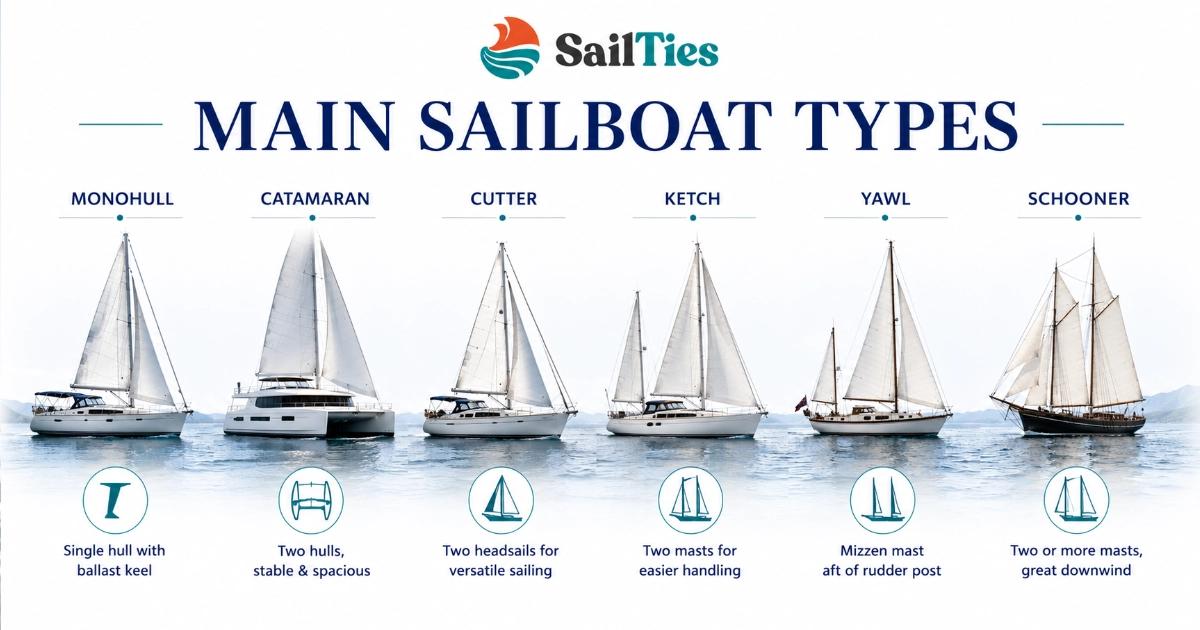
Hull configuration describes how many hulls the boat has. A monohull has one hull and relies on a weighted keel for stability. A catamaran has two parallel hulls and gains stability from its wide beam. A trimaran has three hulls, with the main hull flanked by two smaller outriggers.
Rig configuration describes the number of masts and the arrangement of sails. The most common categories are the sloop, cutter, ketch, yawl, and schooner, each with a different number of headsails or masts.
Most sailors are primarily classifying by rig when they say "I sailed a sloop" or "we chartered a ketch." But hull type shapes the whole experience of being on the boat: how much it heels, how it moves at anchor, how much living space it has, and what conditions it handles best.
For a fuller picture of how these elements come together, Sailties' guide to how a sailboat works covers the core principles behind hull, keel, and sail interaction.
Ready to log your own sailing adventures? Download the Sailties app and start tracking every passage, boat, and milestone.
Scan to download


The sloop: the most common sailboat in the world
The sloop is the starting point for understanding sailboat types. It has a single mast, a mainsail, and one headsail (a jib or genoa). That's it.
The sloop is the most common modern rig because it delivers strong upwind performance with the simplest possible setup. Fewer lines, fewer sails, and less to manage make it the default choice for beginners, day sailors, and the majority of production cruising boats under 40 feet.
There are two main variations. A masthead sloop has the forestay running all the way to the top of the mast, which supports a large headsail and gives excellent sail area for light wind. A fractional rig sloop has the forestay attaching lower on the mast, which allows the top of the mast to flex and the sail plan to be depowered more easily in stronger wind. Fractional rigs are increasingly common on modern performance boats.
The sloop's main limitation is that in heavy weather, you're managing a large headsail that can be difficult to furl quickly on a shorthanded boat. This is where the cutter configuration becomes relevant.
The cutter: the offshore sailor's sloop
The cutter looks like a sloop at a glance: one mast, one mainsail. The difference is that the mast sits further aft, which creates room at the bow for two headsails: a jib on the outer forestay and a staysail on an inner forestay.
The cutter rig is a favorite for offshore and bluewater cruising because it gives a versatile range of sail combinations. In light wind, you fly both headsails for maximum area. As the wind builds, you furl the jib and sail on the staysail alone, which is a smaller, more manageable sail set closer to the center of the boat. Reefing becomes incremental rather than sudden.
This setup makes it easy to shorten sail in rising conditions without drama, which is why cutter-rigged boats appear consistently in logs of longer passages. The trade-off is slightly more rigging complexity than a sloop and a marginally less efficient upwind angle when both headsails are flying.
Sailors planning overnight or multi-day passages often make note of which sail combination they used for each leg. Those logs almost always show cutters spending extended time on the inner staysail alone in winds above 20 knots.
The ketch: two masts for longer passages
The ketch is a two-masted sailboat. The forward mainmast is the taller of the two. Behind it, forward of the rudder post, sits a shorter mizzen mast carrying a mizzen sail.
The ketch is the rig most associated with serious bluewater cruising because it divides the total sail area into smaller, more manageable pieces. Each individual sail is shorter and lighter than what you'd carry on a sloop of the same size. This matters a great deal on shorthanded passages where the crew may be tired, conditions may have changed overnight, and you want to adjust sail without wrestling a large canvas in the dark.
The mizzen sail also provides a useful steadying effect when lying at anchor in a swell, and can be used in combination with the engine for more controlled motoring in tight conditions.
The downside is cost and complexity. An extra mast, extra standing and running rigging, extra sails, and the mizzen taking up space in the aft cabin area all add up. Ketches perform slightly less efficiently upwind than a comparably sized sloop, where having a single large, efficient sail plan has the advantage.
Most ketch sailors in logs are experienced cruisers on boats of 40 feet or more, making passages of several days or longer. The rig suits the context.
Join sailors around the world logging their journeys on Sailties. Download the app and start your own logbook today.
Scan to download
The monohull: the traditional and most widely sailed type
A monohull is any boat with a single hull. The vast majority of sailboats in marinas around the world are monohulls. They range from small dinghies and daysailers to offshore racing yachts and ocean-crossing cruisers.
Monohulls rely on a weighted keel for stability: the keel hangs below the waterline, filled with lead or iron, and counteracts the heeling force of the wind on the sails. This gives monohulls a self-righting characteristic. A knockdown in extreme conditions will right itself because the keel keeps pulling the boat upright. This is considered a fundamental safety advantage for offshore sailing.
The most discussed aspect of monohull sailing for beginners is the heel: the boat tilts under sail, sometimes significantly. Experienced sailors find this natural and responsive, describing it as part of the feel of the boat. Newer sailors often find it disorienting at first. Both reactions are normal. Once you understand the points of sail and how the angle of heel changes with wind angle and sail trim, it becomes intuitive.
Monohulls are also cheaper to buy, cheaper to berth (they fit in a standard marina slip), and cheaper to maintain than catamarans of comparable size. This keeps them dominant in total numbers even as catamarans grow in popularity.
The catamaran: two hulls, growing fast in sailing logs
The catamaran has two parallel hulls of equal size connected by a central bridgedeck. Stability comes from the wide beam between the hulls, not from a keel. This means catamarans sit level in the water and heel very little under sail.
Catamarans are 25 to 30 percent faster than comparable monohulls in most conditions, particularly on a beam reach, because the twin hulls generate less water resistance and the boats are lighter without ballast. Upwind performance is where monohulls close the gap: catamarans cannot point as close to the wind and sometimes struggle to tack in light air without losing momentum.
The living space advantage is significant. Two separate hulls mean private cabin areas separated from the main saloon. The bridgedeck saloon sits above the waterline with natural light and a clear view. Wide, stable decks make moving around the boat comfortable even in a chop. For cruising families and charter groups, the catamaran's layout consistently outscores the monohull.
The main downsides are cost and berthing. Catamarans are significantly more expensive to buy than monohulls of similar length, and most marinas charge for a double berth because of the wide beam. Haul-outs and maintenance are also more complex and costly. And if a catamaran capsizes, it will not self-right: a rare event, but one that shapes how experienced offshore sailors think about hull choice for extreme conditions.
In charter fleets, catamarans have become dominant. In sailing logs from the Caribbean, Pacific, and Mediterranean, they appear with increasing regularity at every level from weekend charters to year-long liveaboards.
The yawl and schooner: less common but worth knowing
Two other types appear in sailing logs less frequently but are worth recognizing.
The yawl looks similar to a ketch: two masts, main mast forward, shorter mizzen aft. The difference is that the yawl's mizzen mast sits behind the rudder post, making it smaller and more of a balancing tool than a source of drive. Yawls are less common on modern boats and most examples you encounter are classic or vintage designs. They are highly regarded for their helm balance and sailing feel.
The schooner has two or more masts, with the aft mast equal to or taller than the forward mast. Schooners carry a large sail area distributed across multiple smaller sails, which makes them excellent in downwind conditions and on reaches. They are harder to tack efficiently than a sloop and carry more running rigging. Most schooners you see under sail today are classic wooden boats or traditional charter vessels.
Conclusion
The sailboat types that show up in real logs are dominated by sloops and catamarans, with cutters and ketches appearing as sailors move toward longer and more serious passages. Each type represents a considered set of trade-offs: between simplicity and versatility, between upwind performance and living comfort, between cost and capability.
Understanding these distinctions helps you read any anchorage, make better choices when chartering, and track your own development as you accumulate time on different boats. If you don't own a boat yet, the fastest way to experience the difference is to find crew on other people's boats.
To build the foundation that makes sense of all of it, explore Sailties' guide to getting started in sailing and the full sailing basics section.
Frequently Asked Questions
What is the most common type of sailboat?
The sloop is the most common sailboat in the world. It has a single mast, a mainsail, and one headsail, making it simple to sail and maintain. The vast majority of production cruising boats and beginner-friendly vessels are sloop-rigged. The sloop's combination of upwind efficiency and ease of handling makes it the default choice for sailors at every level.
What is the difference between a monohull and a catamaran?
A monohull has one hull and relies on a weighted keel for stability. It heels under sail, gives strong upwind performance, and self-rights after a knockdown. A catamaran has two hulls connected by a bridgedeck, gains stability from its wide beam, heels very little, and offers far more living space. Catamarans are generally faster downwind and more comfortable at anchor, but cost more to buy and berth, and will not self-right if capsized.
What type of sailboat is best for beginners?
Most beginners start on a sloop-rigged monohull, which is simple to sail and widely available for lessons and charters. Catamarans are also accessible for beginners because their stability and level sailing platform reduce the learning curve around heel and balance. The best boat for a beginner is usually the one available at a local sailing school, which will typically be a sloop.
What is the difference between a ketch and a yawl?
Both are two-masted sailboats with a shorter mizzen mast aft of the main. The key difference is the position of the mizzen mast relative to the rudder post. On a ketch, the mizzen mast sits forward of the rudder post and contributes meaningfully to drive. On a yawl, the mizzen sits aft of the rudder post and is used primarily for helm balance rather than propulsion. Ketches are more common on modern cruising boats; yawls are more often seen on classic designs.
What sailboat type is best for long ocean passages?
Cutters and ketches are the rigs most commonly logged on bluewater passages. Both offer divided sail plans that allow sail area to be reduced incrementally as conditions change, which matters enormously on a shorthanded boat over several days at sea. Between hulls, experienced offshore sailors tend to favor monohulls for their self-righting ability in extreme conditions, though well-prepared catamarans regularly complete ocean crossings.
Track your next sail. Download Sailties free.
Scan to download