


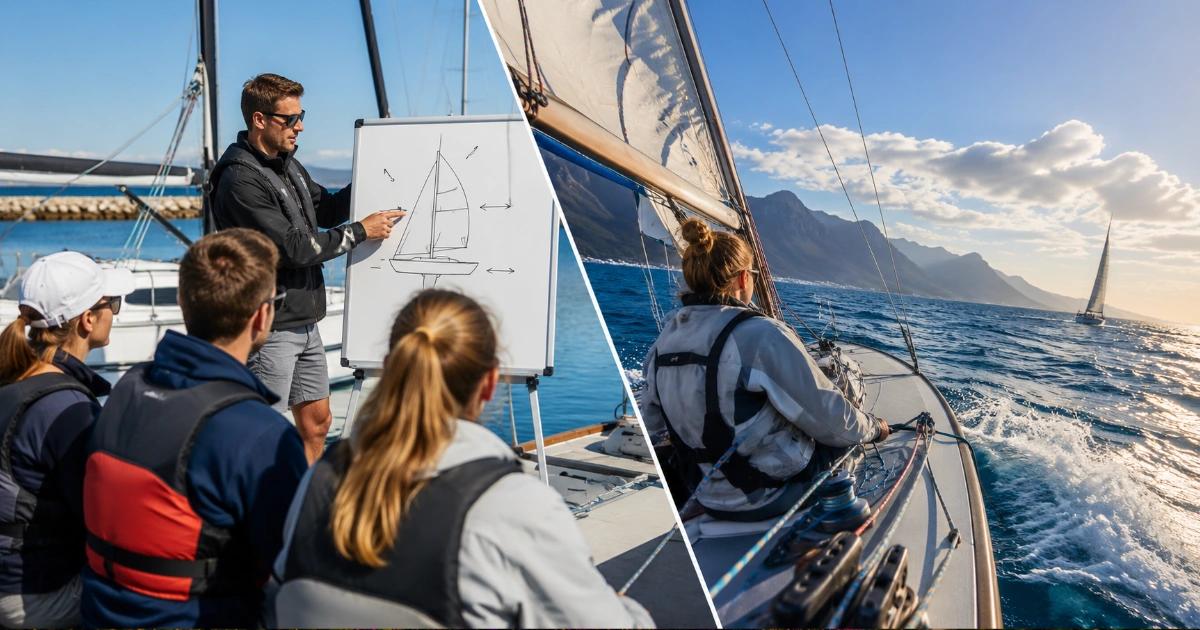
Most people finish sailing school feeling excited. Then they get on the water alone for the first time and realize there's a gap between what they learned and what they actually need to know.
That gap is normal. It doesn't mean sailing school failed you. It means sailing is a skill that takes time to develop beyond any formal course.
This article explains exactly what a sailing school covers, what it doesn't, and how to build real confidence after you've earned your first certification. Whether you're still deciding whether to enroll or you've just finished your first course, this guide will help you set realistic expectations and plan your next steps.
In short:
- Sailing schools cover the fundamentals: terminology, points of sail, basic maneuvers, and safety rules
- Most entry-level courses follow the ASA or RYA curriculum and lead to internationally recognised certifications
- Certification proves minimum competency, not real-world confidence
- Docking in wind, reading changing weather, and handling emergencies require practice beyond the classroom
- The fastest way to close the gap is crewing on other boats, tracking sea time, and sailing in varied conditions
- A sailing school is absolutely worth it, but treat it as a starting point, not a finish line
What Does a Sailing School Actually Teach You?
A sailing school gives you the foundational knowledge and basic on-water skills needed to handle a sailboat safely in light to moderate conditions. Most beginner courses follow the ASA 101 standard, which covers sailing terminology, parts of the boat, points of sail, basic sail trim, rules of the road, and seamanship essentials.
That's a solid foundation. You'll leave knowing how to steer, how sails generate power, how to tack and jibe, and how to avoid collisions. You'll also understand wind direction and how it affects boat behavior, concepts that can take months to pick up on your own.
From there, the ASA curriculum builds progressively: ASA 103 adds coastal navigation, anchoring, and basic engine operation. ASA 104 moves into multi-day bareboat cruising. Each level has a written exam and a practical on-water assessment.
If you're sailing in the UK or Europe, the equivalent framework is the Royal Yachting Association (RYA) training scheme. The entry point is the RYA Competent Crew, which covers the same core skills as ASA 101: crewing a yacht safely, basic helming, and fundamental seamanship.
The next step is the RYA Day Skipper, which combines theory and practical assessments and maps roughly to completing ASA 103 and 104 together. Both pathways lead to the same outcome: a skipper-level certification recognized by charter companies worldwide.
| Level | ASA (USA) | RYA (UK/Europe) |
|---|---|---|
| Beginner / Crew | ASA 101 Basic Keelboat Sailing | RYA Competent Crew |
| Intermediate / Skipper | ASA 103 Basic Coastal Cruising + ASA 104 Bareboat Cruising | RYA Day Skipper (theory + practical) |
For a full breakdown of which qualifications are recognized where, Sailties' guide to sailing qualifications covers both systems in detail.
The structure is useful regardless of which path you follow. A good sailing school compresses months of trial-and-error into a course that teaches you the right habits from day one. By the end, you'll have a clear picture of how a sailboat works, with a certification that proves it.
Scan to download


The Real Value of Getting Certified
A sailing certification is more than a piece of paper. It's a credential that opens doors to chartering boats around the world.
Most charter companies require proof of sailing competence before handing over a boat. ASA certifications are recognized internationally, and over one million certifications have been issued since the association was founded in 1983. RYA certifications (the UK equivalent) are equally respected in European and Mediterranean waters.
There are also practical financial benefits. Some insurance providers lower premiums when policyholders hold recognized sailing certifications. For anyone planning to eventually own a boat, that's worth factoring in.
One thing worth knowing: in the United States, no certification is legally required to sail recreationally, regardless of boat size. But for chartering, and for sailing with confidence, having recognized sailing qualifications matters.
What Sailing School Doesn't Prepare You For
Sailing schools teach you to sail in controlled conditions. That's a deliberate choice: it keeps beginners safe while they learn. But it also means several real-world scenarios are left out of the curriculum.
The skills that take the most time to develop are the ones that require repetition under pressure: docking a boat in crosswind and current, reading fast-changing weather at sea, handling a mechanical failure mid-passage, and managing crew dynamics when conditions deteriorate. Entry-level courses don't cover these in depth, and they can't. There simply isn't enough time.
Specialized docking courses address wind and current management, tight-space maneuvering, and communication techniques that aren't part of a basic keelboat curriculum. Night sailing, reefing in strong wind, and interpreting marine weather forecasts are typically introduced only at the ASA 104 level or higher.
Most graduates are surprised by this gap. They've passed their written and practical exams, but the first time they bring a 35-foot boat into a crowded marina alone, the training doesn't feel like enough. That's not a failure of the school. It's the nature of building any practical skill.
Why Do Certified Sailors Still Feel Unprepared?
Certification proves that you met a minimum standard on a specific day, in specific conditions, with an instructor on board. It does not mean you're ready for everything the water might throw at you.
Confidence on the water is built through muscle memory, and muscle memory takes time. Tacking and jibing, trimming sails efficiently, reading a wind shift before it hits: these actions only become instinctive through repeated practice in varied, uncontrolled conditions. The ASA itself is clear about this: once you've earned your certification, the next step is to practice, practice, practice.
This is why liveaboard courses accelerate learning faster than weekend classes. Spending days and nights on a boat forces you to manage every aspect of sailing: anchoring, weather, boat systems, watch-keeping. There's no instructor to fall back on when the sun goes down.
Expedition-based programs take this further still. Courses that involve hands-on training around the clock cover weather interpretation, navigation without electronics, and crew leadership in a way that no classroom can replicate. The result is a different kind of competence: not just theoretical knowledge, but judgment formed under real conditions.
How to Keep Building After Sailing School
The period immediately after sailing school is the most important for skill development. Here's how to make the most of it.
Scan to download
Crew on other people's boats. This is the fastest way to accumulate sea time without owning a boat. Join a sailing club, sign up for crew lists, and say yes to as many passages as you can. Every new boat and every new skipper teaches you something different.
Charter regularly. Renting a boat for a weekend puts you in the skipper's seat without the cost of ownership. Start in familiar waters, then push into more challenging conditions as your confidence grows.
Track your sea time. A sailing logbook is your proof of experience. It matters when you apply for advanced certifications, work with charter companies, or build a sailing resume. The habit of recording your passages also sharpens your judgment about what you've done and what you still need to practice.
Take an intermediate liveaboard course. Once you've completed ASA 101 and 103, a multi-day liveaboard course is the single biggest step you can take toward real confidence. The combination of continuous sailing and onboard living accelerates skill development in a way that day sessions simply can't match.
Is a Sailing School Worth It for Beginners?
Yes. A sailing school is worth it for anyone who wants to learn to sail properly.
It gives you a structured, safe environment to learn the fundamentals, and it teaches safety from the very first session. Without formal instruction, most beginners develop bad habits that take years to unlearn. A qualified instructor catches those habits early. The certification you earn also opens access to charter boats around the world, something that's hard to achieve any other way.
When choosing a school, prioritize on-water hours over classroom time. Look for small group sizes, which lead to more personalized instruction. Check that the instructors are certified and experienced, not just qualified on paper. And consider whether the school's conditions match the kind of sailing you want to do: a school on a sheltered lake will give you a different experience than one operating on open coastal waters.
The best sailing schools don't just teach you to pass an exam. They give you the confidence to go out and keep learning on your own.
Conclusion
Sailing school is where your sailing life begins. It gives you the vocabulary, the safety habits, and the baseline skills to get on the water without putting yourself or others at risk. The certification you earn is real and recognized. And it matters.
But it's a starting point. The sailors who progress quickly after school are the ones who treat their certification as an invitation to keep learning: crewing on every boat they can find, logging sea time consistently, and gradually pushing into more challenging conditions.
For those who want to see the full picture, the ASA and RYA frameworks extend well beyond the beginner level. Here is how the complete pathway maps across both systems:
| Level | ASA (USA) | RYA (UK/Europe) |
|---|---|---|
| Beginner / Crew | ASA 101 Basic Keelboat Sailing | RYA Competent Crew |
| Intermediate / Skipper | ASA 103 Basic Coastal Cruising + ASA 104 Bareboat Cruising | RYA Day Skipper (theory + practical) |
| Advanced Coastal | ASA 105 Coastal Navigation + ASA 106 Advanced Coastal Cruising | RYA Coastal Skipper |
| Offshore / Passagemaking | ASA 107 Celestial Navigation + extensive sea time | RYA Yachtmaster Offshore |
| Ocean / Professional | ASA 108 Offshore Passagemaking | RYA Yachtmaster Ocean |
Each level builds on the last. The jump from Day Skipper to Coastal Skipper introduces night sailing and longer passages. Yachtmaster Offshore requires documented sea miles and a rigorous practical exam conducted by an external examiner. The ocean is the top of the ladder, covering celestial navigation and the planning skills needed for ocean crossings.
If you're just getting started, explore Sailties' guide to getting started in sailing and our breakdown of sailing qualifications to map out your next steps. The water is patient. Keep sailing.
Frequently Asked Questions
What is the best sailing school certification for beginners?
For most beginners, ASA 101 (Basic Keelboat Sailing) is the standard starting point. It covers the core skills needed to handle a small to mid-size sailboat in light to moderate conditions, and it's recognized by charter companies worldwide. In the UK and Europe, the RYA Competent Crew course is the equivalent starting point.
Can you sail independently after completing ASA 101?
Technically yes. ASA 101 certifies you to skipper a sloop-rigged keelboat up to 27 feet in light to moderate conditions in familiar waters. In practice, most graduates benefit from more supervised time on the water before going out alone. Progressing to ASA 103 (Coastal Cruising) gives you a more complete skill set for independent sailing.
How long does it take to feel confident after sailing school?
It varies, but most sailors report feeling genuinely comfortable after 20 to 50 hours of additional practice on the water post-certification. The key factor is variety: sailing in different conditions, on different boats, and in different roles (skipper and crew) accelerates development faster than repeating the same route.
What's the difference between ASA and RYA sailing certifications?
The ASA (American Sailing Association) is the main certification body in the United States and the Americas, focused on cruising and chartering. The RYA (Royal Yachting Association) is the UK equivalent, widely recognized across Europe, the Mediterranean, and internationally. Both are respected by charter companies worldwide. The main practical difference is geography: ASA certifications are more useful in the US and Caribbean, while RYA certifications carry more weight in European waters.
How many hours of practice do you need after sailing school?
There's no fixed number, but the ASA recommends consistent practice after each certification level. As a general guide, 20 to 30 hours of additional sailing after ASA 101, across varied conditions, gives most sailors a solid base before progressing to ASA 103. Liveaboard courses are the most efficient way to accumulate quality hours quickly.