


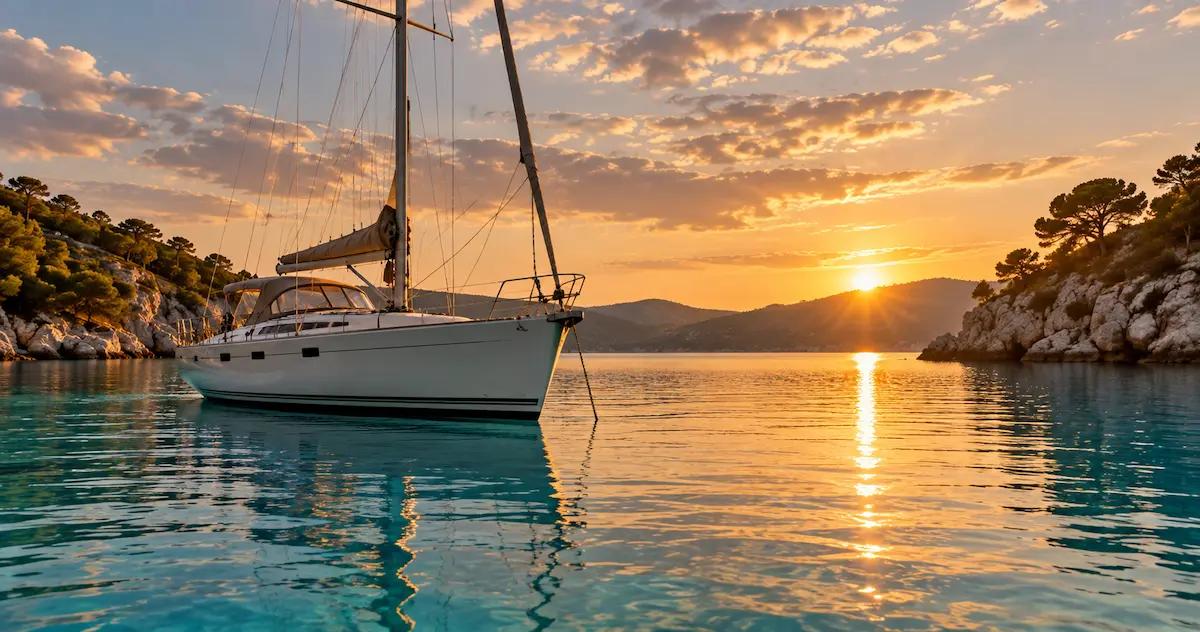
Sailors anchor in real conditions by choosing a sheltered spot with good holding, approaching slowly into the wind or current, laying enough rode for the depth and conditions, backing down under power to set the anchor, then checking the position against fixed shore references to confirm it's holding.
The steps are the same on a calm afternoon or in a crowded, windy anchorage. What changes is how much margin sailors build in: more scope, more swinging room, and a closer eye on the transits when conditions get harder.
In short:
- Scope (rode length relative to depth) matters more than anchor size: 5:1 for calm conditions, 7:1 or more once wind or swell picks up
- Approaching into the wind or current, not across it, keeps the boat controllable while the anchor goes down
- Backing down under power at low revs is how sailors actually confirm an anchor is holding, not just guessing
- Two fixed transits on shore, not just the GPS, are the most reliable way to detect dragging
- Holding ground varies hugely: sand and mud hold well, weed and rock are unreliable without extra care
- A snubber or bridle takes the shock load off the windlass and lets the crew actually sleep
How Do Sailors Actually Anchor in Real Conditions?
Sailors anchor in real conditions by treating it as a five-step process: choosing the spot, approaching correctly, laying the right scope, setting the anchor by backing down, and confirming it's holding before relaxing.
Skipping straight to dropping the anchor and hoping is how most dragging incidents start. Each step exists because it removes a specific way anchors fail.
Step 1: Choosing Where to Drop the Anchor
The right spot balances shelter, holding ground, and swinging room, and the chart tells you about all three before you ever look at the water.
Chart symbols for the seabed matter: S for sand and M for mud both hold well, while Wd for weed and Rk for rock need extra care or a different anchor entirely. Shelter from the forecast wind and swell direction matters as much as shelter from what's blowing right now, since conditions can shift overnight. Enough swinging room for your scope, plus the boats already anchored nearby, avoids a collision if the wind shifts.
Step 2: Approaching and Laying the Rode
- Approach slowly into the wind or current, not across it, so the boat stays controllable and stops roughly where intended
- Lower the anchor under control rather than in a pile: a heap of chain on top of the anchor is one of the most common reasons it never sets
- Let the boat drift back as the rode pays out, instead of motoring it out in a straight line, so the chain lies flat along the bottom
- Lay the full scope for the conditions before putting any load on it: 5:1 in calm, sheltered water, 7:1 or more once wind or swell picks up
Getting the whole sequence right is much easier with two people, one on the helm and one on the bow, so short-handed sailors often look to find extra hands for a passage like this before heading out.
Step 3: Setting the Anchor by Backing Down
Backing down under engine, gradually increasing revs, is how sailors confirm an anchor has actually dug in rather than just landed on the bottom.
Start in reverse at idle, then increase to moderate revs once the rode comes tight. A boat that stops firmly, with the bow dipping slightly and the rode staying taut, has set. A boat that keeps creeping backward, or a rode that suddenly goes slack then snatches tight, means the anchor is skipping rather than digging in, and it's worth re-laying.
Step 4: Confirming the Anchor Is Holding
The same transit trick used to check a position underway without staring at a screen works just as well for checking an anchor isn't dragging.
Line up two fixed objects on shore, a building and a headland, or two markers, right after the anchor sets. If that transit stays lined up over the next twenty minutes, the anchor is holding. A GPS anchor alarm is a useful backup, but the transit gives an instant visual check with no waiting for the GPS position to update.
Log every anchorage, not just every passage.
SailTies lets you save GPS position, scope, and holding ground for every anchorage, so you know exactly what worked the next time you're back.
Scan to download


Step 5: Anchoring in Wind, Swell, or a Crowded Anchorage
Harder conditions call for more of everything: more scope, more swinging room, and more attention, not a different process.
A snubber or bridle, a length of nylon line taking the load off the chain and windlass, absorbs the jerking that otherwise transmits straight through the boat in a swell or gusty wind. In a crowded anchorage, matching scope to the boats nearby, rather than just to the depth, avoids everyone swinging differently and colliding overnight.
Scope by Condition
How much rode to let out depends on conditions more than on any single rule. The table below is a starting point:
| Condition | Recommended scope | Notes |
|---|---|---|
| Calm, sheltered, daytime stop | 3:1 to 5:1 | Fine for a lunch stop with someone aboard |
| Overnight, moderate wind | 5:1 to 7:1 | Standard cruising scope for most anchorages |
| Strong wind or swell | 7:1 to 10:1 | More scope reduces the angle of pull on the anchor |
| Rocky or weedy bottom | Increase 1 to 2x standard | Anchor is less reliable, extra scope and a trip line help |
Choosing the Right Anchor for the Job
Every step above assumes the anchor on the bow is a reasonable match for the boat and the bottom; see Sailties' guide to which anchor to choose for your boat if you're not sure yours is.
Build a record of anchorages that actually held.
Download SailTies for free and start logging your anchor spots alongside your passages, one searchable record instead of scattered memory.
Scan to download
Conclusion
Anchoring in real conditions comes down to the same five steps whether it's a calm afternoon or a blustery evening: pick a sheltered spot with good holding, approach into the wind or current, lay the right scope, set the anchor by backing down, and confirm it's holding with a transit before relaxing. The steps don't change; how much margin you build into each one does.
Anchoring well under real conditions is also one of the core skills tested in most sailing qualifications, since examiners care about the judgment behind each step, not just the mechanics.
Frequently Asked Questions
How much anchor rode should I let out?
How much anchor rode to let out depends on depth and conditions, but a scope of 5:1 (five times the depth plus freeboard) is standard for calm, sheltered overnight anchoring, rising to 7:1 or more once wind or swell picks up.
What is the correct scope for anchoring overnight?
The correct scope for anchoring overnight is usually 5:1 to 7:1 in moderate conditions, meaning 5 to 7 times the total depth of water plus the height of the bow above the waterline. Stronger wind or swell calls for 7:1 to 10:1.
How do I know if my anchor is dragging?
You know your anchor is dragging if a transit between two fixed objects on shore keeps shifting, or if a GPS anchor alarm shows the boat has moved beyond its expected swinging circle. Checking a transit right after setting the anchor, then again periodically, is the most reliable manual method.
Should I anchor with chain or rope rode?
Chain rode holds better than rope for the same length, since its weight helps keep the pull on the anchor horizontal, which is why most cruising boats use all-chain or a chain-and-rope combination. A snubber is recommended with all-chain rode to absorb shock loads that would otherwise transmit straight to the windlass.
What is backing down on an anchor?
Backing down on an anchor means reversing under engine power, gradually increasing revs, to confirm the anchor has dug into the bottom rather than just landed on it. A boat that stops firmly with a taut rode has set; one that keeps creeping backward hasn't.
Do I need a snubber when anchoring with all-chain rode?
Yes, a snubber is recommended when anchoring with all-chain rode, since chain has no stretch and transmits every jerk from wind or swell straight to the windlass and cleat. A nylon snubber line absorbs that shock load and makes for a quieter, safer night at anchor.